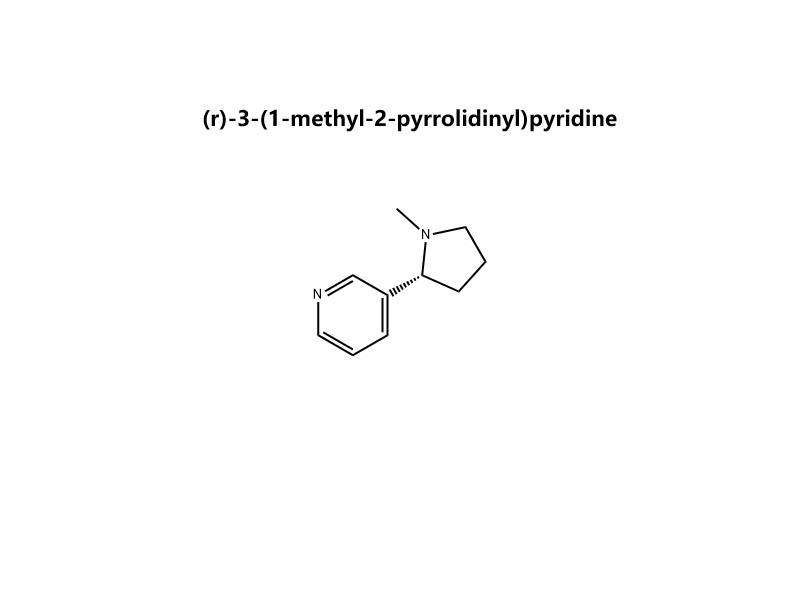
Nombre IUPAC: (R)-3-[(2S)-1-Metilpirrolidin-2-il]piridina o (R)-1-Metil-2-(3-piridil)pirrolidina
Nombre común: (R)-(−)-Nicotina; Nicotina natural
Fórmula química: C₁₀H₁₄N₂
Peso molecular:162,23 g/mol
Rotación específica: [α]²⁰_D = aprox. -166° (puro)
Estructura: Una piridina (C₅H₄N) sustituida en la posición 3 con un grupo 1-metilpirrolidin-2-ilo con configuración (R).
Apariencia: Líquido aceitoso, transparente, de color amarillo pálido a marrón. Se oscurece al exponerse al aire y a la luz.
Punto de ebullición: ~ 247 °C (se descompone)
Punto de fusión: < -80 °C (Líquido a temperatura ambiente)
Densidad: ~1,01 g/cm³ a 20 °C
Presión de vapor:~0,0425 mmHg a 20 °C
Solubilidad: Miscible con agua y la mayoría de los disolventes orgánicos (etanol, éter dietílico, cloroformo) en todas las proporciones a temperaturas inferiores a 60 °C. Actúa como una base débil (pKa del ácido conjugado: piridinio ~3,1, pirrolidinio ~7,9).
Estabilidad: Inestable en condiciones alcalinas; volátil con vapor. Se oxida y oscurece tras una exposición prolongada al aire. Las sales (por ejemplo, diclorhidrato, tartrato) son más estables para su almacenamiento.
Farmacología primaria: A Agonista potente de los receptores nicotínicos de acetilcolina (nAChRs)en los sistemas nerviosos central y periférico. Esta actividad subyace a todos sus efectos fisiológicos.
Efectos: Actúa como estimulante en dosis bajas, aumentando la frecuencia cardíaca, la presión arterial y la liberación de neurotransmisores como la dopamina (asociada con la recompensa y la adicción) y la norepinefrina. Las dosis altas actúan como un agente bloqueador despolarizante en las uniones neuromusculares, lo que provoca toxicidad.
Toxicidad: Altamente tóxico (LD50 oral, rata: ~50 mg/kg). Los síntomas de intoxicación aguda incluyen náuseas, vómitos, taquicardia, hipertensión, convulsiones e insuficiencia respiratoria. Un conocido teratógeno y sustancia adictivadebido a su rápida acción sobre las vías de recompensa del cerebro.
Metabolismo: Se metaboliza principalmente en el hígado por la enzima citocromo P450 2A6 (CYP2A6) para producir cotinina (metabolito principal) y otros compuestos.
Biosíntesis natural: En la planta de tabaco (Nicotiana tabacum), se sintetiza en las raíces y se transporta a las hojas. La vía comienza con ácido aspártico y gliceraldehído-3-fosfato, procediendo a través de una serie de pasos que involucran putrescina, N-metilputrescina y el intermediario clave, el ácido nicotínico. El anillo de pirrolidina se deriva de la ornitina/putrescina, y el anillo de piridina del ácido nicotínico (un derivado del aspartato). La enzima final, nicotina La sintasa cataliza la reacción de acoplamiento, produciendo el enantiómero (R)-(−)-naturalmente exclusivo.
Producción sintética: Se puede producir mediante síntesis química o extracción y purificacióna partir de biomasa o residuos de tabaco. Se utilizan rutas sintéticas avanzadas (síntesis asimétrica, resolución enzimática) para producir nicotina (R) de alta pureza, evitando el enantiómero (S) no deseado, para aplicaciones farmacéuticas y de consumo avanzadas.

Productos farmacéuticosTerapias para dejar de fumar: El ingrediente activo en Terapia de reemplazo de nicotina (TRN) productos (chicles, parches, pastillas, inhaladores) para aliviar los síntomas de abstinencia.
Investigación neurológica: Una herramienta estándar en la investigación preclínica para estudiar la función del receptor nicotínico de acetilcolina (nAChR), los mecanismos de adicción y las posibles terapias para la enfermedad de Parkinson, el deterioro cognitivo y la colitis ulcerosa (donde los parches de nicotina han demostrado cierto efecto).

AgroquímicosHistóricamente utilizado como potente insecticida natural(actúa sobre los receptores nAChR de los insectos). Su uso está actualmente muy restringido o prohibido en muchos países debido a su toxicidad para los humanos.

Cigarrillos electrónicos y líquidos para vapearEl principal agente adictivo en los productos que contienen nicotina líquidos electrónicosEl cambio hacia la "nicotina sin tabaco" (TFN, por sus siglas en inglés) a menudo se refiere a la nicotina (R) producida sintéticamente, comercializada por su pureza y consistencia.
Principales ventajas y beneficios
1. Especificidad y potencia biológica inigualables.
Beneficio: El El enantiómero (R) es la forma exclusiva que se presenta de forma natural.con una estructura tridimensional óptima para la unión a los subtipos de nAChR de mamíferos. Esto garantiza efectos precisos, reproducibles y biológicamente relevantesen sistemas experimentales.
Escenario de aplicación: En investigación avanzada en neurofarmacologíaAl estudiar las vías de la adicción o la función cognitiva, el uso de (R)-nicotina elimina la variable de confusión del enantiómero inactivo (S), lo que garantiza que los efectos observados sobre la liberación de dopamina o la activación neuronal sean precisos y atribuibles únicamente a la forma activa.
2. Fundamental para la investigación validada y la estandarización.
Beneficio:Sirve como el estándar de referencia definitivo para cuantificar los niveles de nicotina y estudiar su metabolismo, toxicología y farmacocinética.
Escenario de aplicación: En laboratorios de toxicología forense o de control de calidad farmacéuticaSe utiliza para calibrar sistemas HPLC-MS/MS para la medición precisa de nicotina y sus metabolitos (como la cotinina) en muestras biológicas, lo que garantiza resultados defendibles desde el punto de vista legal y médico.
3. Fundamental para el desarrollo de productos de nicotina modernos.
Beneficio:Proporciona una Ingrediente farmacéutico activo (API) consistente y de alta pureza.Libre de impurezas específicas del tabaco (TSNA, por sus siglas en inglés) que pueden surgir durante la extracción, algo crucial para los perfiles de seguridad.
Escenario de aplicación: En el desarrollo de terapias de reemplazo de nicotina (TRN) de próxima generación o bolsitas libres de tabaco reguladasLa nicotina sintética (R) permite una dosificación precisa, perfiles de sabor más limpios y un argumento regulatorio más sólido con respecto a la pureza y caracterización del producto.
4. Permite realizar estudios de relación estructura-actividad (SAR).
Beneficio:El enantiómero puro es el andamiaje fundamentalpara que los químicos farmacéuticos diseñen y prueben nuevos análogos para posibles terapias dirigidas a los receptores nAChR.
Escenario de aplicación: En programas de descubrimiento de fármacos para trastornos neurológicos (por ejemplo, Parkinson, esquizofrenia, dolor), los investigadores modifican la estructura de la (R)-nicotina para crear nuevos compuestos con actividad selectiva de subunidades receptoras, con el objetivo de conservar los beneficios cognitivos al tiempo que se eliminan el potencial de adicción y los efectos secundarios.
(R)-3-(1-Metil-2-pirrolidinil)piridina (Nicotina natural (R)-(−)-, CAS 25162-00-9) no es un producto químico básico sino un Herramienta bioquímica altamente especializada e ingrediente activo de precisión.Su principal ventaja es su pureza enantiomérica, que está directamente vinculado a su eficacia biológica, validez de la investigación y aceptabilidad regulatoriaEs indispensable para Investigación neurológica de vanguardia, estandarización analítica y desarrollo de productos avanzados y bien caracterizados para la administración de nicotina.Para los investigadores y desarrolladores de productos, obtener nicotina (R) de alta pureza es una inversión en integridad de datos, consistencia del producto y credibilidad científica, lo que distingue su trabajo de estudios o productos que dependen de mezclas racémicas menos definidas.
Preguntas frecuentes (orientadas al cliente)
P1: ¿Cuál es la diferencia entre la nicotina (R) y la nicotina racémica?
A: El El enantiómero (R) es la forma biológicamente activa que se encuentra de forma natural. con alta afinidad por los nAChR. La nicotina racémica (una mezcla 50/50 de las formas (R) y (S)) suele ser un subproducto de la síntesis química no estereoselectiva. El enantiómero (S) tiene una afinidad por el receptor significativamente menor y una farmacocinética diferente. Para investigación y aplicaciones de alta gama, enantiomérico La pureza (>99% (R)) es fundamental. para una respuesta biológica precisa y un rendimiento constante del producto.
P2: ¿Cuáles son los requisitos críticos de manipulación y almacenamiento?
A: Se requiere extrema precaución. Debe manejarse de una manera campana extractoracon el EPI apropiado (guantes, gafas, bata de laboratorio). Almacenar bajo una atmósfera inerte (argón/N₂) en un Recipiente oscuro y herméticamente cerrado. at 2-8°C. Comprarlo y almacenarlo como un forma salina estable Se recomienda encarecidamente el uso de (p. ej., diclorhidrato) para mejorar la seguridad y la vida útil. Consulte siempre la Hoja de Datos de Seguridad (SDS).
P3: ¿Qué grados de pureza están disponibles y qué debo especificar para mi aplicación?
A:
Grado técnico (~95%):Para aplicaciones industriales no críticas (por ejemplo, investigación de insecticidas).
Grado farmacéutico (pureza química >99%): Obligatorio para el desarrollo de productos NRT.
Grado de alta pureza enantiomérica (>99,5% (R)): Esencial para Investigación avanzada en neurofarmacología y TFN sintético para líquidos de vapeo.donde la interacción precisa con el receptor y el perfil de sabor son primordiales. Especifique siempre pureza química, exceso enantiomérico (ee) y niveles de disolvente residual.
P4: ¿Cuál es el marco regulatorio para la compra y el uso de este compuesto?
A: Es fuertemente reguladocomo sustancia controlada/precursor en la mayoría de las jurisdicciones.
EE. UU.: Regulado por la FDA y la DEA. Su venta suele estar restringida a instituciones de investigación cualificadas y fabricantes autorizados.
UE: Sujeto a estrictos controles conforme a las normativas de seguridad química y del consumidor (por ejemplo, REACH, CLP). En el caso de los productos para vapear, la Directiva sobre productos del tabaco (TPD) establece límites de concentración.
Cumplimiento: Los compradores deben proporcionar documentación de uso finaly prueba de cumplimiento con las regulaciones locales. Para su uso comercial en productos de consumo (cigarrillos electrónicos), se requieren expedientes toxicológicos exhaustivos y autorización de comercialización.
P5: ¿Puede utilizarse como estándar en ensayos analíticos?
A: Sí, es el estándar de referencia principal.para cuantificar la nicotina en muestras de tabaco, farmacéuticas y toxicológicas mediante HPLC, GC-MS o LC-MS. Para ello, debe obtener un Material de Referencia Certificado (CRM)De un proveedor cualificado, con un certificado de análisis que detalla la pureza exacta y la trazabilidad.
P6: ¿Cuáles son las principales consideraciones logísticas y de aprovisionamiento?
A: Debido a su clase de peligro (6.1, tóxico), envío de mercancías peligrosas especializadas (HAZMAT)es obligatorio, lo que aumenta el costo y la complejidad. Los plazos de entrega pueden ser largos. Fuente de Proveedores de ingredientes químicos finos o farmacéuticos de buena reputación y con trayectoria. Con amplia experiencia en el manejo de alcaloides. Desconfíe de las discrepancias en los precios, ya que los precios muy bajos pueden indicar mezclas racémicas, baja pureza o procedencia irregular.


 Español
 English
 Español
 Português

![4-Nitrophenyl 3-(Benzo[d][1,3]dioxol-5-yl)-2-methylpropanoate](https://es.qixiolivetol.com/storage/uploads/images/202604/17/1776427287_qZy87IjHSQ.jpg)

 CONTÁCTENOS


 IPv6 RED SOPORTADA
|
IPv6 RED SOPORTADA
|